
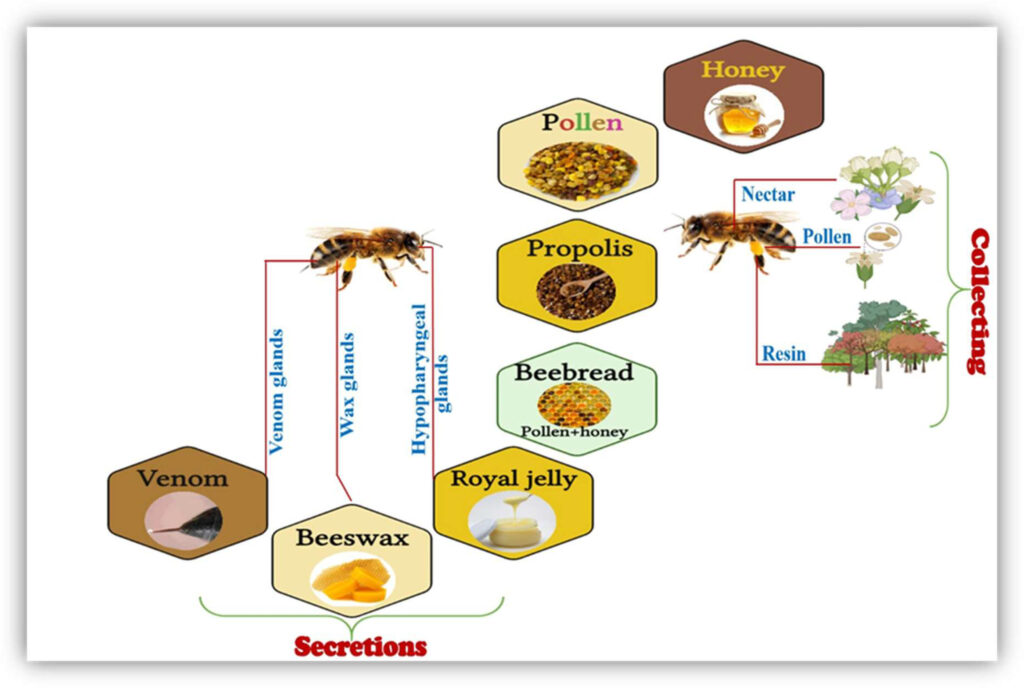
Most of us will use harvested honey as a dietary carbohydrate. I trust you were satisfied with the honey you were able to harvest this season? Your honey might be directly consumed or used to sweeten beverages, desserts, salads, cooked into main dishes, be dribbled on toast and used to help keep baked goods fresher for a longer period of time. Honey is a natural sweeter, perhaps preceding all other concentrated sugar sources to benefit human nutrition.
There is another important side to honey and that is in human medicine. Not so much main stream medicine but primarily in traditional medicine practices and as an alternative treatment for clinical conditions ranging from wound healing to cancer treatment. Although we cannot directly promote honey (and other bee products) in human health, friends and neighbors, members of your own family and customers will likely use honey as a medicine. The honey my family in Bolivia sells is almost entirely for medicinal purposes or as a carrier to help the medicine go down.
A mega-review of 108 published studies from 1970 to 2014, published in 2017 by 3 Medical professors at two of Iran’s prestigious Medical schools, summarize articles that report honey to ”….. exert antioxidant, antimicrobial, anti-inflammatory, antiproliferative, anticancer, and antimetastatic effects”. As an antioxidant, those extra substances secreted by flowers in their nectar, the flavonoids and polyphenols, are the two main bioactive molecules.
The authors additionally report: “ Many evidences suggest the use of honey in the control and treatment of diabetes mellitus, cancer, asthma, and also cardiovascular, neurological, and gastrointestinal diseases. The antioxidant properties are thought to be why honey is of value in colon cancer and for gastrointestinal diseases.
A second review published by 4 Egyptian authors in Biotechnology Reports discusses the history of Apitherapy and current state of the art, including some very innovative approaches. It includes 169 citations to literature. It is well worth examining.
Development of Manuka honey was one of its most significant advances promoting the beginning of main stream medical use of honey as a wound dressing. It is possible to sterilize Manuka honey via gamma radiation without destroying Methylglyoxal (MGO). This substance disrupts bacterial cell membranes. MGO has been shown to be effective against a range of bacteria, including those resistant to antibiotics like Methicillin-resistant Staphylococcus aureus (MRSA). Apparently it will work to make antibiotics more effective.
Sterilization ensures that it’s safe to use honey in wound care and for other medical applications. One target is Clostridium botulinum, botulism, found in more than 26% of samples (because a harmful microorganism is present does not mean it will be able to multiply and cause disease). Medical use honey is sterilized by gamma irradiation at dosages of 25–50 k. Heating honey, the other means of eliminating potential harmful microorganisms like botulism, denatures components, such as glucose oxidase, which contributes to the antibacterial action of honey.
As a wound dressing, honey forms a protective barrier over a skin wound, preventing the entry of harmful bacteria and reducing the risk of infection. It helps create a moist wound environment, reduces wound dressing odors, facilitates removal of dead tissue and reduces possible scaring. Can your honey do what Manuka honey does in wound dressing? The short answer is yes, and it can help with other human health issues identified by this publication. As with all medicines, it may not work in all instances.
I recommend this article to help you become better informed what your honey might be able to do to improve our health. You will be better informed to respond to those questions about honey in promotion of human health.
Saeed Samarghandian , Tahereh Farkhondeh and Fariborz Samini, 2017. Honey and Health: A Review of Recent Clinical Research. Pharmacognosy Res. Apr-Jun;9(2):121–127. doi: 10.4103/0974-8490.204647
Samia E. El-Didamony, Hend I.A. Gouda, Mahmoud M.M. Zidan, Reham I. Amer. 2024. Bee products: An overview of sources, biological activities and advanced approaches used in apitherapy application. Biotechnology Reports 44, e00862. https://www.sciencedirect.com/science/article/pii/S2215017X24000353